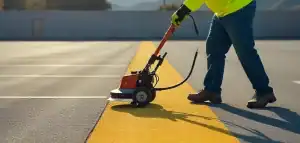

For business owners and property managers across Oklahoma, understanding the rules behind ADA-compliant parking lot striping is not optional. It is the law. The Americans with Disabilities Act (ADA) sets clear, enforceable federal standards that determine how parking lots must be designed, marked, and maintained to ensure equal access for every person, regardless of physical ability.
Parking lot striping in Oklahoma must comply with ADA requirements to ensure accessible parking spaces are correctly located, properly marked, and reliably maintained. Failing to meet these requirements can expose commercial property owners to fines starting at $75,000 for a first violation and up to $150,000 for subsequent violations, not to mention potential civil lawsuits.
Beyond legal exposure, ADA compliance reflects a commitment to inclusive, accessible design. Every time someone with a disability pulls into your lot and finds clear, properly marked accessible spaces and access aisles, your business sends a powerful message: everyone is welcome here. This guide walks Oklahoma commercial property owners through everything they need to know about ADA parking requirements, from space dimensions and signage to maintenance and the restriping process. For professional striping services and compliance support throughout the state, Oklahoma Parking Lot Services (OKPLS) is a trusted resource for property owners and managers looking to meet and maintain ADA standards.
Federal ADA Requirements for Parking Lot Striping

The ADA guidelines governing parking apply to all commercial facilities, medical facilities, public accommodations, and state or local government facilities. Whether you manage a retail strip mall in Oklahoma City, a hospital outpatient facility in Tulsa, or a multi-building corporate campus in Edmond, your parking lot must comply with ADA standards.
The ADA National Network and the U.S. Department of Justice’s ADA regulations provide the governing framework. These rules cover the total number of accessible spaces required, space dimensions, access aisle widths, signage, slopes, and the accessible route connecting the parking facility to building entrances.
Accessible Space Dimensions and Layout
Standard accessible car spaces must be at least 8 feet wide, accompanied by an adjacent access aisle that is a minimum of 5 feet wide. Van accessible spaces require a wider footprint: the space itself must be at least 11 feet wide with a 5-foot access aisle, or it may be 8 feet wide with an access aisle that is at least 8 feet wide on the passenger side.
The maximum slope for both parking spaces and access aisles is 1:48 (approximately 2%) in all directions. Steeper slopes can make it difficult or impossible for wheelchair users to safely transfer to and from their vehicles, so proper grading is essential during both initial construction and restriping projects.
Access aisles must be marked to discourage parking within them. The striping pattern typically uses diagonal lines to signal that the area is reserved for vehicle access, not additional parking. Spaces and access aisles must be on a level, stable, firm surface.
Number of Required Accessible Parking Spaces
The minimum number of accessible spaces required is determined by the total number of parking spaces in a given parking facility. The ADA provides a clear accessible parking spaces table to guide this calculation:
| Total Parking Spaces in Lot | Minimum Accessible Spaces Required |
|---|---|
| 1 – 25 | 1 |
| 26 – 50 | 2 |
| 51 – 75 | 3 |
| 76 – 100 | 4 |
| 101 – 150 | 5 |
| 151 – 200 | 6 |
| 201 – 300 | 7 |
| 301 – 400 | 8 |
| 401 – 500 | 9 |
| 501 – 1,000 | 2% of total |
| 1,001 and over | 20 + 1 per 100 above 1,000 |
Of the accessible spaces required, at least one in every six accessible parking spaces (or fraction thereof) must be van accessible. For example, a parking lot with six accessible parking spaces must include at least one van accessible spot. A lot with twelve accessible spaces must provide at least two van accessible spaces.
For lots with four or fewer spaces total, such as small retail locations, only one accessible space is required, and that space must be van accessible. This is an important rule for smaller Oklahoma businesses that might not realize they still have ADA obligations.
Van Accessible Spaces: Special Requirements
Van accessible spaces require additional vertical clearance along the vehicular route to accommodate the height of accessible vans. The minimum vertical clearance for van accessible parking must be at least 98 inches (8 feet, 2 inches) along the entire access path from the parking structure entrance to the van accessible spaces.
Van accessible spaces require either an 11-foot-wide space with a 5-foot aisle, or an 8-foot space with an 8-foot passenger side aisle. The access aisle must always be on the passenger side of van parking spaces to allow deployment of wheelchair lifts or ramps. Proper van accessibility is one of the most commonly overlooked elements in parking lot striping, making professional compliance reviews essential.
Colors, Markings, and Signage
ADA parking spaces must be clearly marked with the International Symbol of Accessibility, commonly known as the wheelchair symbol, painted on the pavement and displayed on a parking space identification sign. Signs must be mounted at least 60 inches above the finished floor or ground surface, measured to the bottom of the sign, so they remain visible even when vehicles are parked in adjacent spaces.
Van accessible spots must include a sign reading “Van Accessible” beneath the International Symbol of Accessibility. The signage must be mounted on a post or wall at the head of the space and must not be placed in a location where it could be obscured by parked vehicles.
While federal ADA standards do not mandate a specific paint color, blue is the universally recognized standard for accessible parking markings in the United States, and many states and municipalities, including those in Oklahoma, incorporate this convention into their local codes. Always verify applicable local requirements when undertaking a restriping project.
Special Considerations for Oklahoma Commercial and Medical Facilities
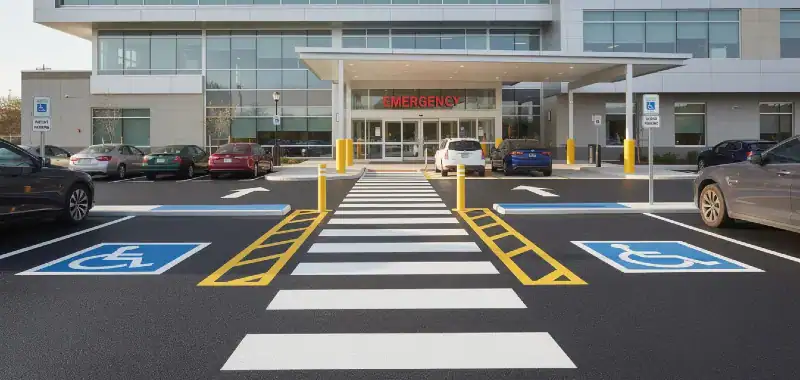
Certain types of facilities have specific requirements that go beyond general ADA parking guidelines. Oklahoma property managers overseeing the following types of facilities should pay close attention.
Hospital and Outpatient Facilities
Hospital outpatient facilities must provide accessible parking spaces based on a higher ratio than standard commercial properties. For outpatient physical therapy facilities and rehabilitation facilities, at least 10% of the total parking spaces provided must be accessible. This elevated requirement reflects the higher likelihood that patients visiting these locations will have mobility impairments.
Medical facilities must also ensure that accessible spaces are located as close as possible to accessible entrances, ideally along the shortest accessible route between the parking lot and building entry. Where multiple accessible entrances exist, accessible spaces should be distributed near each entrance to minimize travel distance for patients.
Residential and Visitor Parking
For residential facilities that include parking, accessible spaces must be provided for specific dwelling units in a ratio that corresponds to ADA guidelines. Visitor parking at residential properties is treated separately; accessible spaces must be provided for visitor parking in the same ratios that apply to commercial facilities.
Separate parking facilities that serve distinct buildings or uses on the same campus should each be evaluated independently. Multiple buildings with separate parking facilities may each require their own set of accessible spaces rather than pooling compliance across a shared lot.
Parking Garages and Structures
Parking garages and multi-story parking structures must comply with the same space ratios and dimensional requirements as surface lots. The key additional consideration for parking structures is vertical clearance; van accessible spaces require a minimum of 98 inches of clearance, which can require structural modifications to older garages.
Angled parking spaces in parking garages present unique challenges for ADA compliance, as the access aisle placement must still ensure that the adjacent access aisle aligns correctly with the passenger side of the vehicle. Professional line striping teams with ADA expertise can navigate these configurations correctly.
Oklahoma-Specific ADA Parking Considerations

While federal ADA regulations set the floor for accessibility requirements, Oklahoma municipalities may adopt additional or stricter local codes. Cities like Oklahoma City, Tulsa, and Norman may have their own zoning ordinances that affect parking lot design, signage requirements, and restriping timelines. Always consult local municipal codes in addition to federal ADA guidelines when planning a striping project.
Oklahoma’s weather, including hot summers, ice storms, and heavy spring rains, can accelerate paint deterioration and make parking lot striping fade faster than in more temperate climates. This means property managers in Oklahoma need to monitor their parking lots more frequently and may need to schedule restriping more often to maintain ADA compliance year-round.
Additionally, existing parking facilities undergoing renovation or restriping in Oklahoma are subject to the same ADA standards as new construction. When restriping parking spaces, property owners must bring the entire parking facility into full ADA compliance; they cannot simply repaint the existing lines without addressing deficiencies in accessible space ratios, dimensions, or signage.
Benefits of Professional ADA Striping Services in Oklahoma
Hiring a professional parking lot striping team is the most reliable way to ensure full ADA compliance. Here is why professional services are worth the investment:
- Precision and accuracy: Professional striping equipment ensures crisp, correctly dimensioned lines that meet exact ADA standards for space width, aisle width, and slope markings.
- Durable materials: High-quality traffic paints and thermoplastics hold up against Oklahoma’s extreme weather, reducing the need for frequent restriping.
- Compliance documentation: Reputable striping contractors can provide documentation of the work completed, which can be valuable if your property is ever subject to an ADA compliance inspection.
- Liability reduction: Proper accessible design protects your business from costly ADA lawsuits and enforcement actions.
- Better first impressions: Clean, well-maintained parking markings signal professionalism and care to every visitor who pulls into your lot.
Cost Breakdown for ADA Parking Lot Striping
The cost of ADA-compliant parking lot striping in Oklahoma varies depending on lot size, the number of accessible spaces required, the condition of the existing surface, and the materials used. As a general guide:
- Standard line striping: $2 – $6 per linear foot
- ADA symbol stenciling: $50 – $150 per space
- Full lot restriping with ADA compliance: $500 – $3,000+, depending on lot size
- Signage installation: $100 – $300 per sign post
These are general estimates. An accurate quote requires a site assessment by a qualified contractor who can evaluate the specific needs of your parking facility.
Step-by-Step ADA Parking Lot Striping Process
Understanding the process helps Oklahoma property managers plan projects efficiently and minimize disruption to daily operations.
Step 1 – Site Assessment: A professional team evaluates the existing parking lot, counts total spaces, identifies accessible spaces required under ADA, checks current compliance status, and notes any surface damage that needs repair before striping.
Step 2 – Layout Planning: Using ADA guidelines, the team maps out the location of accessible parking spaces, van accessible spaces, access aisles, signage placement, and the accessible route to building entrances.
Step 3 – Surface Preparation: The lot is cleaned, and any cracks or surface damage that could affect the durability or appearance of the new striping is repaired.
Step 4 – Striping Application: Using professional line striping machines, the team applies traffic paint or thermoplastic markings to ADA-specified dimensions. The International Symbol of Accessibility is stenciled onto each accessible space.
Step 5 – Signage Installation: Parking space identification signs are mounted at the required height at the head of each accessible space, including van accessible signage where required.
Step 6 – Quality Review: The completed work is reviewed against ADA standards to confirm compliance before the lot is reopened.
Maintenance and Restriping Schedule
ADA parking regulations require that accessible spaces must be maintained in good, usable condition at all times. Faded lines, damaged markings, or obscured signs can constitute a compliance violation even if the original striping was done correctly. Oklahoma property managers should plan for restriping every one to two years, depending on traffic volume and weather exposure.
When restriping parking spaces, the entire parking facility must be brought into current ADA compliance, not just the accessible spaces. This is particularly important for properties with older lots that may have been originally striped under outdated standards.
Common ADA Parking Striping Mistakes to Avoid
- Undersized access aisles: The adjacent access aisle must meet minimum width requirements. Narrowing aisles to fit more spaces is a common and costly mistake.
- Insufficient van accessible spaces: Many property owners forget that one in every six accessible spaces must be van accessible. This ratio is frequently overlooked.
- Incorrect slope: Exceeding the 1:48 maximum slope in spaces and aisles makes the lot non-compliant even if all other dimensions are correct.
- Missing or improperly placed signage: Signs must be mounted at the correct height and must not be blocked by delivery vehicles, law enforcement vehicles, or adjacent parking space occupants.
- Blocking the accessible route: The path between accessible parking and the building entrance must remain clear and unobstructed. Stripping that fails to preserve this route creates a compliance issue.
- Striping to discourage parking incorrectly: Access aisles must be marked to actively discourage parking, but these markings must follow ADA guidelines for pattern and placement.
Frequently Asked Questions About ADA Parking Lot Striping in Oklahoma
What are the exact dimensions for ADA parking spaces?
Standard accessible car spaces must be at least 8 feet wide with a 5-foot adjacent access aisle. Van accessible spaces must be at least 11 feet wide (or 8 feet wide with an 8-foot passenger side aisle). All spaces and aisles must have a maximum slope of 1:48 in all directions.
How many ADA spaces are required for a 100-spot lot?
A parking facility with 76 to 100 total spaces must provide a minimum of 4 accessible spaces. At least one of those four must be van accessible, based on the rule that one in every six accessible spaces must be van accessible.
What color should ADA parking lines be?
Federal ADA regulations do not specify a paint color, but blue is the universally recognized standard and is used consistently across Oklahoma and the rest of the United States. Local ordinances in some Oklahoma municipalities may have additional color requirements, so confirm local rules before any striping project.
Can I stripe my own parking lot for ADA compliance?
Technically, there is no federal law prohibiting self-striping. However, ADA regulations are precise, and errors in space dimensions, aisle width, slope, or signage placement can result in non-compliance. Professional parking lot striping contractors with ADA expertise ensure the work meets all applicable ADA standards and can provide documentation of compliance.
What are the fines for non-compliant parking striping?
Under the Americans with Disabilities Act, civil penalties for first violations can reach $75,000, with subsequent violations subject to penalties up to $150,000. Private lawsuits from individuals denied equal access can also result in high legal costs and settlements.
How often should ADA parking lots be restriped?
Most parking lots in Oklahoma should be evaluated annually and restriped every one to two years. Oklahoma’s climate, including heat, freeze-thaw cycles, and seasonal storms, accelerates paint wear. When restriping parking spaces, all accessible markings must be restored to full ADA compliance.
Do local Oklahoma codes differ from federal ADA striping rules?
Federal ADA regulations set the minimum standard, but Oklahoma municipalities may adopt stricter local codes. Oklahoma City, Tulsa, Norman, Edmond, and other cities may have specific requirements for signage, paint colors, or slope tolerances that exceed federal minimums. Always verify local requirements with your municipality or a qualified contractor.
What is an accessible passenger loading zone?
An accessible passenger loading zone is a designated area where vehicles can pull up to drop off or pick up passengers with disabilities. Where loading zones are provided, at least one must be accessible, with a minimum 60-inch-wide access aisle adjacent to the vehicle pull-up space. These zones must connect to an accessible route leading to building entrances.
Get Your ADA Compliant Parking Lot Striping Quote Today

Oklahoma commercial property owners cannot afford to overlook ADA compliance. From the number of accessible spaces required to van accessible space dimensions, access aisle widths, signage placement, and vertical clearance requirements, the details matter, and getting them wrong can be costly.
At Oklahoma Parking Lot Services, we specialize in professional parking lot striping in Oklahoma that meets all federal ADA regulations and local municipal codes. Our experienced team handles everything from initial site assessment and layout planning to striping application, signage installation, and final compliance review. We serve businesses across Oklahoma City, Tulsa, Norman, Edmond, Lawton, Stillwater, and beyond.
Whether you need a first-time ADA compliance review, a complete lot restriping project, or help bringing an existing parking facility up to current standards, we are ready to help. Contact us today for a free, no-obligation quote and let us make your parking lot a safer, more accessible, and fully compliant space for everyone.
Call us at (405) 251-6162 or email pmgokpls25@icloud.com to get started.